TikTok Ads
TikTok ads click fraud: how to spot bot traffic and fake clicks
TikTok ads click fraud explained: what TikTok says about invalid traffic, how to check placements and landing visits yourself, and how to act on fake clicks.
- By
- Adjira team
- Published
- Reading time
- 6 min read
TikTok ads click fraud is harder to talk about than click fraud on search ads, because there is less written about it and fewer settings to work with. Advertisers notice the same symptoms everywhere: plenty of clicks, few visits that last, and a cost per result that does not match what happens on the website. This guide explains what TikTok itself says about invalid traffic, what you can check in TikTok Ads Manager, and what you can only see on your own site.
What TikTok says about invalid traffic
TikTok describes invalid traffic as "activity on a platform that's created by non-human entities such as bots and automated scripts", and says it addresses it "through third-party anti-fraud certifications and IVT measurement solutions" (TikTok for Business: About TikTok invalid traffic solutions). The same page names TAG's Certified Against Fraud program and measurement partners DoubleVerify and Integral Ad Science.
Two things follow from that. First, TikTok does filter invalid traffic, and the general kind, such as known bots and data center traffic, is the easiest kind to filter. Second, filtering happens with the data TikTok has about the impression and the click. TikTok does not see what a visitor did after landing on your page, and it does not compare that visit with your other ad platforms.
The industry terms are worth knowing. The Media Rating Council's Invalid Traffic Detection and Filtration Guidelines separate general invalid traffic, found with lists and routine checks, from sophisticated invalid traffic, which is built to look human and takes more analysis to spot.
Where TikTok ads bot traffic tends to show up
Advertisers who see suspicious traffic on TikTok usually find it concentrated in a few places:
- Placements outside the TikTok app. TikTok can deliver ads through Pangle, its network of partner apps, and through other app placements. These can reach people cheaply, and the quality varies by app.
- Cheap traffic objectives. Campaigns optimized for clicks or traffic reward the cheapest clicks available, and the cheapest clicks are not always people.
- Broad targeting in new markets. Wide targeting in countries you do not normally sell to can bring traffic you cannot easily judge.
- Lead generation. Instant forms can attract fake or low quality submissions, as on any platform.
None of these is proof of TikTok ads click fraud. They are the places to look first.
How to check TikTok ads click fraud yourself
1. Tag every ad so visits can be traced
TikTok adds a ttclid parameter to the landing URL when click tracking is on. Keep the full landing URL in your logs or analytics, and add UTM parameters so each visit maps to a campaign, ad group and ad. Without this, you cannot tie a suspicious visit back to what you paid for.
2. Compare clicks with sessions per ad group
Export clicks per ad group from TikTok Ads Manager and compare them with the sessions your analytics records for the same UTM values over the same dates. Some loss is normal: slow pages, in-app browsers and consent choices all reduce recorded sessions. A much larger gap on one ad group than on the others is the signal.
3. Check placements
Look at which placements your ad groups use. If you use automatic placement, try an ad group limited to the TikTok app and compare its click to session ratio and its conversions with the automatic version. If the partner placements bring many clicks and few real visits, you have learned something useful. Our guide to TikTok Pangle invalid traffic explains how to run that test fairly.
4. Look at the visits behind the clicks
On your own site, look at the paid visits that carry a ttclid:
- Who owns the network? Home broadband and mobile carriers are normal. Hosting providers are not.
- Does the browser time zone match the IP location?
- Did the visitor scroll, tap or read, or leave within a second or two?
- Does the same device appear again and again from different IP addresses?
5. Read the leads
If you run instant forms, export a week of leads. Repeated names, invalid phone numbers, made up email addresses and submissions that arrive in bursts all point to low quality or automated activity.
TikTok ads fake clicks or just a weak ad?
Low engagement is not the same as fraud. A video that grabs attention but has a weak link to the offer will bring real people who leave quickly. A landing page that loads slowly in the TikTok in-app browser will lose real people before it appears. Before you call it TikTok ads bot traffic, check:
- Does the landing page load quickly on a mid-range phone on mobile data?
- Does the page match what the video promised?
- Are conversions low for every placement, or only for some?
If conversions are low everywhere, the ad or the page is the likely cause. If they are low on one placement or one ad group that also shows hosting networks and identical devices, invalid traffic is the likely cause.
What to do about TikTok ads invalid traffic
- Limit placements. If partner placements bring the suspicious visits, run the ad group on the TikTok app only and compare results.
- Optimize for a deeper event. Optimizing for a conversion event you track with the TikTok Pixel or Events API pushes delivery toward people who act, rather than toward the cheapest clicks.
- Narrow targeting. Remove countries and audiences where suspicious visits cluster and that do not bring sales.
- Contact TikTok with evidence. If you believe you were charged for invalid traffic, contact TikTok support through Ads Manager with dates, ad groups and examples. The TikTok page we read does not describe an advertiser credit process, so we do not describe one here.
Where Adjira helps with TikTok
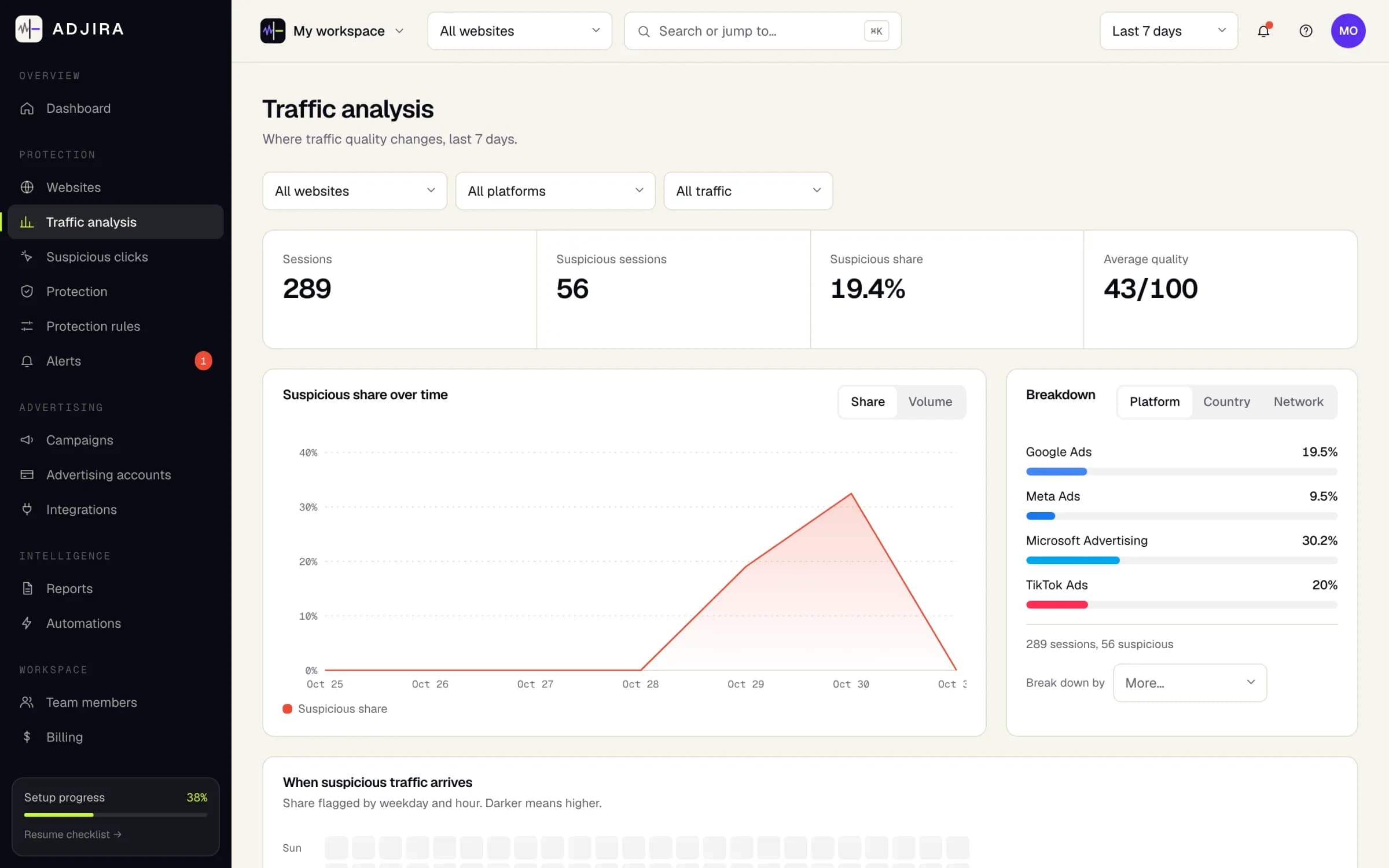
Adjira connects to TikTok Ads read-only and matches visits on your site to campaigns using the click identifier. Each paid session gets a fraud risk score with evidence, network checks for VPN, datacenter and proxy traffic, and same person detection across devices and networks. You see suspicious spend per campaign as an estimate, next to the same figures for your other platforms on the campaign and platform comparison.
TikTok's API does not support the exclusion lists Adjira can push to Google Ads and Microsoft Advertising. For TikTok, Adjira gives you the evidence, and you make the changes in TikTok Ads Manager. The TikTok Ads integration page lists what the connection reads.
The same approach works on Facebook and Instagram. See how to check Meta ads bot traffic.
Frequently asked questions
Is there click fraud on TikTok ads?
Invalid traffic exists on every large ad platform, and TikTok publishes a page on how it addresses it with third-party certifications and measurement partners. Filtering catches much of the general kind. What gets through is easiest to see by checking the visits on your own website.
How does TikTok define invalid traffic?
TikTok describes invalid traffic as activity on a platform that is created by non-human entities such as bots and automated scripts, and says it addresses it through third-party anti-fraud certifications and invalid traffic measurement solutions.
How can I tell bot clicks from real TikTok visitors?
Look at the visit after the click. Hosting provider networks, a browser time zone that does not match the IP location, the same device from many IP addresses and no interaction on the page are signs of automation. Compare these against your normal paid traffic.
Can I get a refund for TikTok invalid clicks?
The TikTok help page we read does not describe an advertiser refund or credit process, so we cannot say how one works. Contact TikTok support through Ads Manager with your evidence if you believe you were charged for invalid traffic.
Should I turn off TikTok partner placements?
Test it rather than guess. Run one ad group on the TikTok app only and one with automatic placement, then compare sessions, engagement and conversions. Keep the version that brings real buyers at the lower cost.